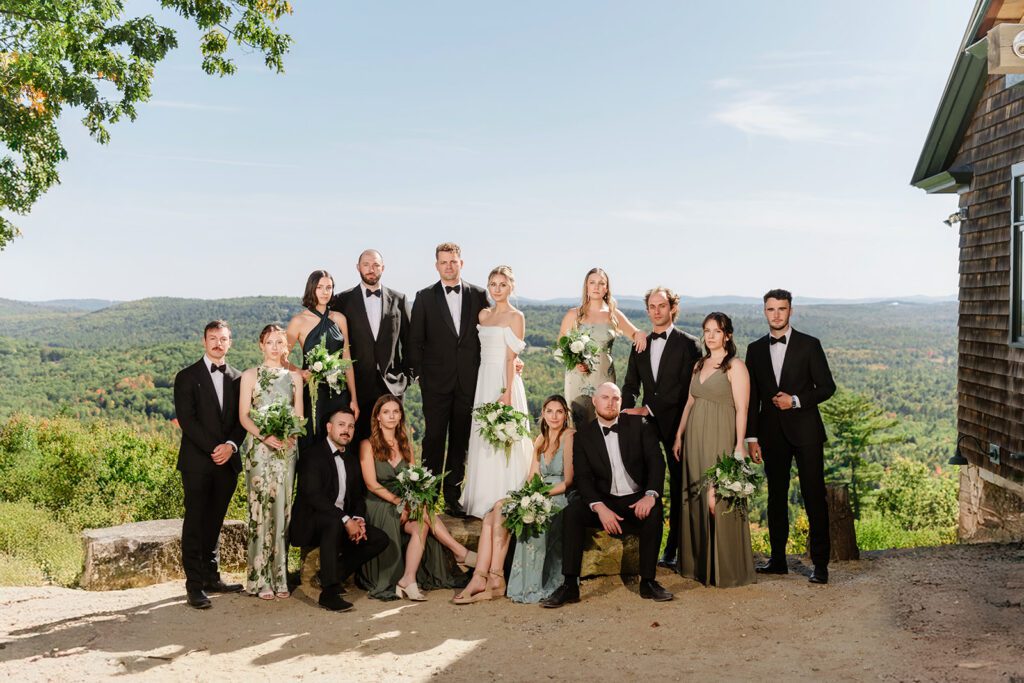
Wedding Photography Coverage Hours: A Boston Photographer’s Guide to 7-Hour vs. 13-Hour Timelines (Including Full Catholic Ceremonies)
Every couple asks some version of the same question: how much wedding photography coverage do we really need and how do I go about creating a wedding day timeline? You don’t want to just download some template off Etsy, but that’s a good baseline to work off of. Real days provide real-life hiccups. I’ve been photographing for over a decade, so I’ve seen all kinds of things that can go wrong.
Here’s the truth: your wedding day doesn’t run on a clock. It runs on light, on people, on traffic, on how long it takes a bridal party of nine to get out of a church and into cars. My job is to build a timeline around your actual day, not force your day into a timeline. What follows is a guide to what 7 hours and 13 hours of coverage really look like — and why the difference between them is bigger than six hours on a contract.
Want the real *nitty-gritty* breakdown on “Getting Ready” photos? (This is where I see the timeline breakdowns happen most) read this post.
One more thing to know upfront: I shoot solo as a single photographer unless you add a second shooter to your package. That’s a wonderful thing for the intimacy and consistency of your images — but it also means I can only be in one place, photographing one moment, at a time. A lot of the guidance below is really about planning around that one simple fact and building a realistic wedding day timeline.

Your 7-Hour Day Wedding Timeline (Base Coverage)
Seven hours is a beautiful, complete option — and it’s the right fit for a specific kind of day: one location, or two at most, a tight-knit group, and a wedding day timeline that doesn’t ask you to be in three places before dinner. Think of it as the day distilled to its essential moments, without the padding.
Sample flow (as a solo, single-shooter photographer — see the breakdown below for why Hour 1 is the one to plan carefully):
- Hour 1 — Getting-ready details and candids (this hour fills up fast — see “What Actually Fits in Hour 1” below before you build your wish list)
- Hour 2 — First look (if you’re doing one) and couple portraits, or wedding party and family formals if you’re saving your first look for the aisle
- Hour 3 — Ceremony
- Hour 4 — Family formals, wedding party photos, and a short window for just-married portraits, often layered into cocktail hour so nothing feels rushed
- Hour 5 — Reception begins: entrances, first dance, toasts
- Hour 6 — Dinner service, cake cutting, parent dances
- Hour 7 — Open dancing and a graceful exit
This works beautifully when your ceremony and reception are under one roof, or a short walk apart. It gets tighter — noticeably tighter — the moment you add a second or third location, because travel time comes out of your seven hours, not in addition to them.
What Actually Fits in Hour 1 (The Part Everyone Underestimates)
“Getting ready” sounds like one thing on a timeline. In practice, it’s a stack of smaller things, and each one has its own real-world minimum. Here’s what actually goes into that window, so you can build a wish list that fits the time you’ve booked instead of one that doesn’t:

| What you might want | Realistic time | Notes |
|---|---|---|
| Detail & flatlay photos (rings, invitations, dress, shoes, jewelry) | 30 minutes | Optional, but the most-requested add — worth planning for if it matters to you |
| Getting-ready-in-PJs / robe candids/Bridal Boudoir | 20-30 minutes | Optional; a favourite for relaxed, unposed moments |
| Changing into the dress | 20–30 minutes | Buttons, zippers, veils — this always takes longer than it looks, especially with a bustle or a long train |
| Bridal portraits | 20 minutes | Once dressed and ready, this is dedicated time just for you |
| Groom portraits | 30 minutes total | 10 minutes of travel to his location + 20 minutes of shooting |
Add those up and you’re already well past an hour — for one partner. And here’s the piece that’s easy to miss: because I’m one photographer, I can only be in one place at a time. I can’t shoot bridal prep and groom prep simultaneously, so if both of you want full getting-ready coverage in a single location, that block needs meaningfully more than an hour to do it without rushing.
There’s one more thing that quietly eats time and rarely gets planned for: everyone who wants to be in a photo needs to already be dressed and camera-ready before I arrive at that spot. If a bridesmaid is still doing her hair when I get there for the group shot, we’re not shooting — we’re waiting. Waiting time isn’t photo time, and it adds up fast.

Your two options if you want the full menu for both of you:
- Add hours on the day of — built into your contract, no renegotiating needed
- Add a second shooter — so both of you get full, simultaneous getting-ready coverage without either of you waiting on the other (see your contract for add-on pricing)
Neither is required — plenty of couples happily trim the list to what matters most and keep it inside Hour 1. In my portfolio, 99% of the weddings are just a single photographer. I can make it work by moving to the groom while you’re changing, or by having your friend style a flatlay while I swoop in to photograph it. I just need to build the time into your wedding day timeline. The information about adding a second photographer is here so you can choose intentionally, not discover it mid-morning on your wedding day.
Your add-on option: Because I know wedding days have a way of expanding once you’re actually planning one, every base package includes the option to add coverage hours on the day itself. It’s built right into your contract — no renegotiating, no scramble. If the afternoon is running long, or you realize halfway through getting ready that you want me there for one more hour of dancing, you can just tell me at the end of the night to stay.
How to Make Your Wedding Morning More Efficient (Before I Even Walk In)
Here’s a secret every experienced wedding photographer will tell you: the smoothest, most beautifully documented wedding mornings aren’t the ones with the most hours booked — they’re the ones with the most preparation done before the photographer ever arrives. A little planning here saves real minutes on your actual timeline, and those minutes turn straight into more relaxed, more meaningful photos. Here’s exactly how to set your morning up for success.
Keep the Prep Room Clean and Clutter-Free
Candid getting-ready moments are some of the most emotional, most cherished images from your whole day — but a room full of takeout containers, empty hangers, and half-packed overnight bags will fight against every photo taken in it. Before I arrive, do a five-minute sweep:
- Make the bed
- Move water bottles, coffee cups, and trash out of frame and off nightstands (a bathroom or closet works great)
- Designate one corner for bags, phone chargers, and personal items
- Keep the area near your windows clear — that’s where the best natural light lives, and it’s where I’ll be photographing most
Twenty minutes of tidying (you can assign a few friends to manage this) now saves you from looking back at your getting-ready photos and only seeing the clutter in the background.
Pre-Plan Your Flat Lay and Send Me a Photo
Flat lay detail shots — your rings, invitation suite, shoes, perfume, jewellery — tell the opening chapter of your wedding day story, and they’re one of the most requested images from this part of the morning. However, it’s not something every couple wants to spend 30 minutes on because they would rather document the moments. Here’s the efficiency trick almost nobody tells you about: you don’t have to leave the styling to chance on the day of.
- Gather everything into one designated box or bag ahead of time so it’s not scattered across three different rooms
- Have a detail-oriented friend or your planner arrange the items in a layout you love
- Snap a quick phone photo of that layout and send it to me in advance, so I know exactly how you envision it styled
- If you love that photo, have your friend recreate the same layout on the morning of — I’ll walk in and be able to shoot it immediately instead of styling from scratch
A truly polished, Pinterest-worthy flat lay can take upward of an hour to style from nothing. Luxury photographers don’t tell you that they sometimes do it on another day and just build that into their $20k+ price. Pre-approving the layout means we can recreate your vision in a fraction of that time — which means more of your hour goes toward portraits and candid moments instead of arranging jewellery on a table.
Prep Your Dress on Its Final Hanger
If you bought a decorative hanger for your gown, have someone transfer it onto the hanger and remove any plastic packaging before I arrive. Cut unneeded strings off. Trains and delicate fabric are often tricky to style well on the fly, so if you have a specific vision for how your gown should be photographed hanging, tell me in advance. This alone can save ten to fifteen minutes that would otherwise go toward untangling packaging instead of photographing your dress.
Don’t Be the Last One in the Hair and Makeup Chair
This is the single biggest timing decision of your entire morning, and it’s worth making on purpose. Hair and makeup artists often prefer the bride to go last, so her look stays as fresh as possible for the ceremony. Photographers, understandably, want the opposite — full hair and makeup completed with enough runway left for solo bridal portraits and emotional photos with parents and your wedding party.
If your morning runs behind (and mornings often do), whoever is last in the chair is the one who loses their photo time. A great artist can keep your look fresh for an extra 30–45 minutes; that tradeoff is almost always worth it for the portraits and mother-daughter or father-daughter moments you’ll treasure for decades. Talk this through with your hair and makeup team ahead of time so everyone is planning around the same priorities.

Coordinate Photo Locations With Your Planner and Florist
If you’re planning a first look or portraits in a specific spot, loop in your planner and florist early. The location should be fully photo-ready — florals delivered, clutter cleared, lighting set — by the time we arrive for photos, not while we’re standing there waiting for it to come together. This is especially true for popular, high-traffic spots where we’re working around a tight window of good light.

Think Twice About Face-Framing Tendrils
They photograph beautifully in a single still frame under perfect conditions — and can behave unpredictably everywhere else. Wind, hugs, and movement can pull them loose or across your face, and during a ceremony that can mean losing your profile in candid shots. If they matter to you, ask your stylist for a way to keep them anchored while still framing your face, and consider testing how they hold up in motion before your wedding morning. 90% of brides who have outdoor weddings, especially by the ocean, are cursing their tendrils a quarter of the way through the wedding timeline.
Make sure your Wedding Planner understand What Your Assistant or Second Shooter Actually Covers
Every photography team structures this differently. Most wedding planners won’t even ask and will assume there will be two photographers. They won’t have access to your contract, so just inform them if they want to do a timeline. I’ve had some experiences where the wedding planner doesn’t even change their clients’ names on the document. Don’t assume they’ve made this timeline specifically for you. My base packages include a photography assistant who helps with lighting, gear, and logistics — and may step in as a second shooter for key moments like the first look or ceremony — without providing full independent coverage of both partners getting ready at once. If you want dedicated, simultaneous coverage of both getting-ready locations, that’s an upgrade worth discussing (see your contract for add-on options).

Build in Buffer for the Small Stuff
Waiting for an elevator. A missing garter that turns up in the wrong bag. A bathroom break in a dress with fifty buttons. None of these are dramatic, and all of them are completely normal — but none of them are accounted for in a bare-bones timeline either. A little cushion here is what keeps your morning feeling calm instead of like a countdown.
None of this is about perfection — it’s about giving your morning the best possible chance to unfold the way you pictured it, so the time we do have together goes entirely toward the photos and the moments that matter most.

Your 13-Hour Day (Full Day Coverage) Wedding Timeline
Thirteen hours is what I’d call true full-day storytelling. This is the option for couples who want the whole arc — quiet morning light, the walk down the aisle, the last song of the night — with room to breathe between each one. It’s also the timeline that makes sense the moment your day involves a full Catholic Mass, more than one location, or both.
Sample flow for your wedding timeline (full Catholic Mass, two locations):
- 9:30 AM — Arrival for getting-ready details and candids, both partners if separate locations
- 10:30 AM — Final touches, dressing, private first look or first-look-with-parents (this window runs longer than an hour on purpose — see “What Actually Fits in Hour 1” in the 7-hour section for why)
- 11:45 AM — Departure for the church, allowing real travel time, not optimistic travel time
- 12:30 PM — Arrival at church — no need to arrive a full hour early. Mass begins at 1:00, so this is a relaxed 30 minutes for family to gather and for quiet moments, not an hour of standing around waiting on an empty church.
- 1:00 PM — Full Nuptial Mass begins (budget 75–90 minutes for a complete Mass with the marriage rite, readings, homily, and Eucharist — this is sacred time, and it should never feel rushed on your account)
- 2:30 PM — Recessional, receiving line if you’re doing one, photos with family and clergy at the church
- 3:15 PM — Departure for portrait location or reception venue
- 3:45 PM — Wedding party and couple portraits, using this window for a second location if desired
- 5:00 PM — Cocktail hour (this often overlaps with the natural “Catholic gap” between an early-afternoon Mass and an evening reception — a lovely, unhurried stretch of the day)
- 6:00 PM — Reception entrance, toasts, dinner
- 7:30 PM — Cake, parent dances, open dancing
- 9:30 PM — Sparkler exit or last dances captured, coverage wraps
Those thirteen hours aren’t padding — it’s the difference between a Mass that unfolds at its own unhurried pace and one where I’m watching the clock instead of watching you. It’s room for a second portrait location without anyone feeling rushed. It’s coverage that starts with morning light and ends with the string lights on.

One Location vs. Multiple Locations — What Actually Changes
This is the single biggest variable in how much time you need in your wedding timeline.
One location (getting ready, ceremony, and reception all in the same venue, or close enough to walk) is efficient by nature. Every hour of coverage goes toward photographing you — not toward getting from one place to another. This is why a seven-hour package works so well for single-venue days.
Multiple locations change the math entirely, and here’s the part that often gets glossed over: moving a photographer is not like moving a guest.
When your guests move between venues, they get in a car or a limo, they’re driven door to door, and they arrive. That’s it. When I move between locations, here’s what’s actually happening:
- Breaking down gear — cameras off, lenses swapped and capped, lighting equipment (if we used any) powered down and packed, everything secured so nothing gets damaged in transit
- Carrying it all out — often down stairs, through crowds of your own guests, sometimes across uneven ground in heels-unfriendly conditions (I’ve done this in cobblestone alleys more times than I can count)
- Walking to the car — which, depending on where I could park, might not be close
- Driving — through actual city traffic, not theoretical traffic. In Boston, that might mean a five-minute drive that becomes twenty because of a Sox game, a road closure, accident, tourists, or construction that wasn’t there last week
- Finding parking — this alone can eat fifteen minutes that no timeline accounts for
- Unloading and setting back up — gear out, checked, ready to shoot again
- Bathroom break – I’m human. I have to hydrate constantly to do my best work. This means I need a bathroom break. I’ve experienced heat stroke in the past because I skipped hydration. I don’t want to experience it again.
None of this is a complaint about the work — I love this part of the job. But it is real time, and it has to live somewhere in your wedding timeline. A location change that “should only take twenty minutes” routinely takes forty-five once you count all six of those steps. Building that reality into your wedding timeline, rather than hoping for the best, is exactly how we protect your day from feeling rushed. Don’t forget to schedule in breaks for yourself to decompress and just take a breath.
Why “Assessing the Light” Isn’t a Five-Minute Task
Here’s something couples rarely think about until they’re standing in it: arriving at a new location doesn’t mean I can just start shooting. I’m reading the space in real time — where the sun is, whether that beautiful open field is in full harsh midday light or soft and shaded, whether the “quiet garden” from the venue’s website now has a tour group in it, whether there’s scaffolding on the building we planned to use as a backdrop.
Real scenarios I plan for:
- The light we scouted three months ago isn’t the light we get. Clouds roll in, or the sun is lower than expected because your timeline shifted by forty minutes earlier in the day. I need a few minutes to find the next-best option, not force the original plan.
- Construction appears overnight. Boston is a city under permanent, cheerful renovation. A backdrop that was pristine at your engagement shoot can have a chain-link fence around it by your wedding day.
- Tourists and foot traffic. Near City Hall, the Common, or anywhere downtown, we’re sharing the frame with a lot of people who did not get the memo that it’s your wedding day. Working around that — waiting for a gap, reframing, finding an angle — takes patience, and patience takes minutes.
- Unwanted clutter. A dumpster, a delivery truck, a row of parked cars where we hoped for a clean street — sometimes we move the shot, sometimes we wait it out, sometimes we work around it creatively. All three take time to figure out.
Problem-solving in the moment is not instant, and it shouldn’t be. The difference between a photo that feels effortless and one that feels forced is often just a few extra minutes of me quietly figuring out the best possible version of the shot in front of me, instead of settling for the fastest one. Help me do my best work for you.

The Real Reason an Extra Hour Matters in your wedding timeline
It’s not about getting more photos, though you will. It’s about what that hour does for you.
An extra hour means we don’t have to sprint from the ceremony straight into family formals while your guests are still congratulating you. It means if the light at your first location isn’t working, we have room to try a second spot instead of forcing it. It means if your ceremony runs fifteen minutes long — and it will, they always do — the rest of your day doesn’t collapse like dominoes. You need time to account for the family member that rushed to the bathroom after the 1 hour Catholic Mass. I need time to set up lights if we change locations. All of that takes time in your wedding timeline. Build it in so you can be present and not just running around.
Buffer time is not wasted time. It’s the quiet insurance that lets you actually be present in your day instead of watching me watch the clock. My favourite weddings to shoot are the ones where nobody, including me, feels like we’re racing anything. That’s not luck — that’s built into the wedding timeline on purpose.
So when you’re deciding between packages, ask yourself less “how many hours do I need to check every box” and more “how much room do I want to breathe.” I’ll help you figure out exactly where that number lands for your day — and if you need more time than you thought once we’re in it, that option is always right there in your contract, ready when you are. You can always just do a la carte add-ons at my hourly rate. Or you can upgrade your package before your wedding day.
Frequently Asked Questions for the Wedding Timeline
How many hours of wedding photography coverage do I need? Most couples land somewhere between 7 and 13 hours, depending on how many locations are involved, whether you’re including a full Catholic Mass, and how much of the reception you want documented. A single-location wedding with a simple ceremony can comfortably work with 7 hours. A day with a full Mass, multiple locations, and a full reception into open dancing generally calls for closer to 13.
How long does a full Catholic wedding Mass take? Budget 75–90 minutes for a complete Nuptial Mass, which includes the marriage rite, readings, homily, and Eucharist, on top of the standard 30–45 minutes for a ceremony without Mass. Always confirm the expected run time with your priest, since every parish runs slightly differently. Then add-on time to say your good-byes.
Do I need a second photographer for my wedding? Not always — it depends on your priorities. My portfolio is 99% created with just myself and my husband/assistant. A second shooter becomes valuable when you want full, simultaneous coverage of both partners getting ready in separate locations, or coverage during your cocktail hour when we’re off doing portraits. It’s worth discussing early, since it’s typically an add-on rather than included automatically.
What’s the best way to prepare for getting-ready photos? Keep your prep space clean and clutter-free, plan your flat lay in advance and send a reference photo, avoid being last in the hair and makeup chair, and make sure anyone who wants to be photographed is dressed and ready before the photographer arrives. A little preparation here goes a long way toward a relaxed, unhurried morning.
Can I add more hours of coverage on my wedding day? Yes — every base package is built with a day-of add-on option written into the contract, so if your day is running long or you decide you want more coverage once you’re in it, extending is simple and doesn’t require renegotiating anything in advance.
What if it rains on my wedding day? I’m game for it! Just have some trusty clear umbrellas ready. Or if you want me to bring mine (they have black handles, clear plastic), just let me know. Here’s an example of how it may look: Rainy Engagement session in Downtown Boston.
What if I just want to enjoy my day? The 13-hour package makes it all stress-free
Want to read more?
How to prepare for getting ready photos
How long does “getting ready” actually take?